Mission Statement
The Institute for Hygiene and Applied Immunology as a part of the Center for Pathophysiology, Infectiology and Immunology is an interdisciplinary facility of the Medical University of Vienna, which was founded from the Institute for Hygiene and the Department for Molecular Immunology.
Our Goal: The comprehensive prevention of diseases through
- Application of hygiene measures and prevention of infections
- The effectivity of disinfectants and disinfecting procedures, as well as their improvement
- Understanding the molecular processes of a body’s natural prevention systems, namely the immune system
The institute aims to recombine the knowledge and techniques of all experts working in its various sub-groups (antigen recognition, medical-technical hygiene, molecular immunology, water hygiene and water microbiology and ticks and tick-associated microorganisms) to develop and introduce hygiene measures immunomodulating agents to create a base for novel substances for the treatment of infections, as well as immunological diseases like autoimmune diseases and allergies.
The Cluster of Excellence
As part of the excellence initative "excellent=austria" cooperative projects are being conducted at eleven locations. This initiative is funded by the Austrian Science Fund FWF, which provides a total amount of 135 Million Euros to foster cutting-edge research regarding future-oriented topics. This amount of funds has never been invested into projects of basic research before in Austria.
For each cluster teams of more than 100 scientists cooperate for at least five years across institutions.
For the topic "Microbiomes Drive Planetary Health", 30 scientists of different fields and seven facilities work together to uncover the significance of microbial communities for the Earth's health and its resident species, while populating all ecosystems and larger organisms.
Furthermore, the institute houses the accredited testing and inspection center API Hygiene Vienna, which is run by the research groups Water Hygiene and Medical-technical Hygiene and adds to our range of services.
Two new publications by the Water Microbiology Working Group in journals from the Nature Portfolio
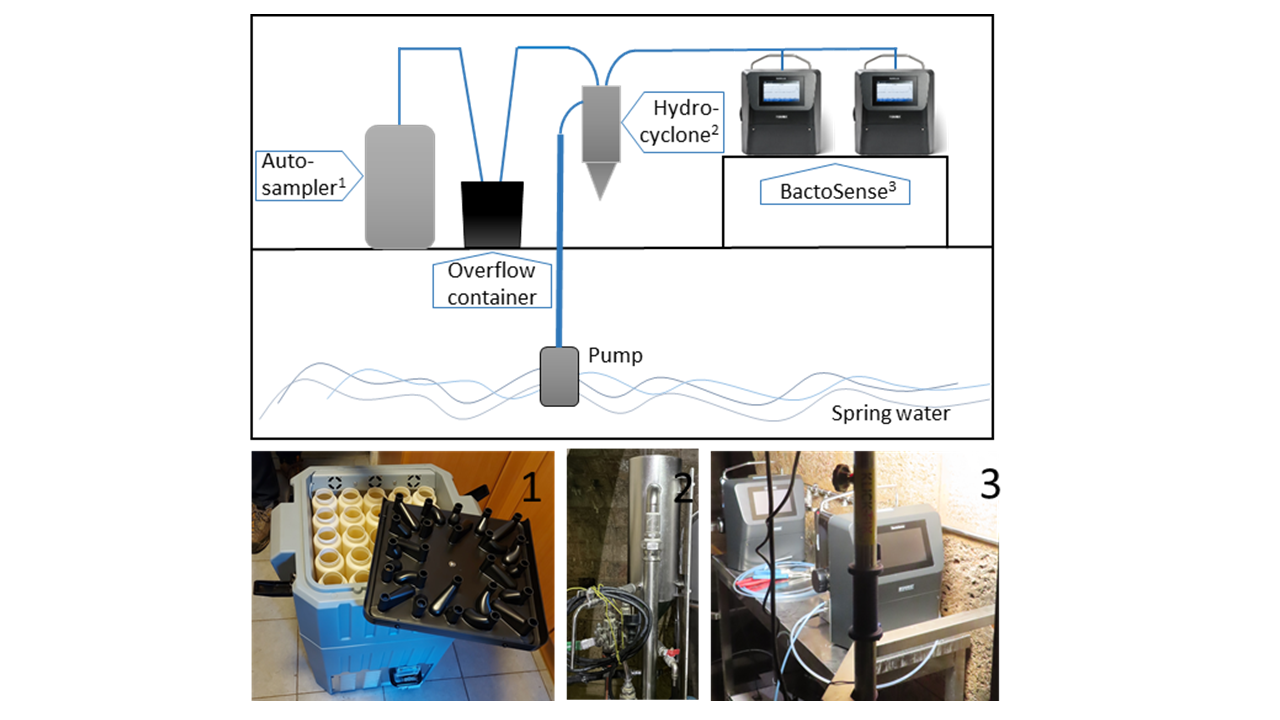
In the paper published in the Nature Publishing Journal “npj Clean Water” with Lena Campostrini as first author and Alexander Kirschner as corresponding author (https://doi.org/ 10.1038/s41545-025-00536-5), the applicability of automated flow cytometry for near-real-time determination of bacterial cells for operational monitoring of alpine drinking water sources was tested in collaboration with Wiener Wasser. The instruments used in the study functioned reliably under difficult field conditions and detected soil-associated and fecal microbial contaminants from surface runoff in the catchment area just as well as the physical-chemical proxy parameters currently in use. When predicting fecal source pollution using machine learning, the combination of microbiological and abiotic (near) real-time indicators achieved the best results. The complementary use of automated flow cytometry thus shows great potential for water safety planning by enabling timely and specific measures to ensure water quality.
The perspective article published in the journal Nature Sustainability (https://www.nature.com/articles/s41893-025-01753-z), with significant contributions from Alexander Kirschner, focuses on the increasing spread of antimicrobial resistance (AMR) and its dangers to human health on a global scale. There is general consensus that measures are needed at critical control points to reduce AMR, but also that activities within a single area of the One Health concept (human, animal, or environmental) are not sufficient and must cover all compartments. Building on research findings from the last ten years, comprehensive, systemic, and integrative strategies are described that address the impacts of anthropogenic activities and the complex relationship between humans, animals, and the environment as central aspects for cross-sectoral and global measures to contain AMR. The publication emerged from a workshop at the last EDAR-7 conference (Environmental Dimension of Antimicrobial Resistance) in Montreal.